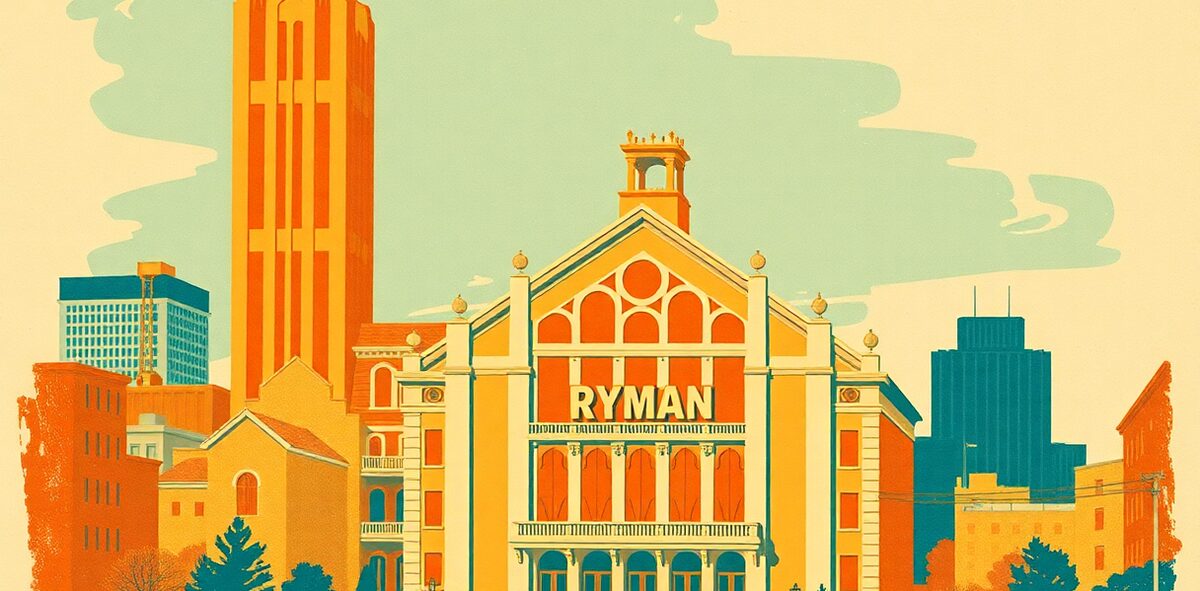
Ryman Auditorium Guide


Non-negotiable: the Ryman is the church country music was born in — original pews, tabernacle acoustics, and the ghosts of Hank, Patsy, and Cash. Hear a show here, not just the daytime tour, because the room only fully works with music in it.
Why it earns the stop
The building opened in 1892 as the Union Gospel Tabernacle, which is why you’re sitting in curved wooden pews, not stadium seats — the single detail that makes the “Mother Church of Country Music” nickname literal. From 1943 to 1974 it was home to the Grand Ole Opry, the longest-running radio broadcast in American history, on the air since 1925. Those three decades are when country music turned from regional sound into national industry, and it happened in this 2,362-seat room.
Three things the blurb glosses. First, the acoustics are engineered by accident: a gospel hall built to carry an unamplified preacher’s voice turns out to be near-perfect for a fiddle and a steel guitar. Second, when the Opry moved to Opryland in 1974, workers cut a circle out of this stage floor and set it into the new Opry House, so modern stars still stand on Ryman wood. Third, the Opry doesn’t stay gone — it returns to the Ryman every winter, which is the one window to hear the actual broadcast in the actual church.
The move
Skip the instinct to just tour it. Buy a ticket to a show — a winter Opry night if you can catch the residency, or any concert on the calendar the rest of the year. The ~$30 daytime tour is the fallback, not the goal. If you’re chasing the Opry specifically, confirm whether that night’s broadcast is at the Ryman downtown or the Grand Ole Opry House out at Opryland before you pay — they’re 20 minutes and two entirely different rooms apart.
The honest catch — what to skip
The self-guided daytime tour, done alone, is a quiet museum walk — fine, but it’s the room without its reason for existing. Don’t build your Nashville night around it. Skip the assumption that “the Opry” always means the Ryman; most of the year it’s out at Opryland. And if a fiddle in a pew isn’t your thing, this pick isn’t for you — the Ryman rewards people who came for the music, not the selfie in the lobby.
Nearby
The Ryman sits a block off the neon. Pair it with a crawl through the honky-tonks on Lower Broadway, a morning at the Country Music Hall of Fame and Museum, or the summer madness of CMA Fest. It’s one of the flagship picks on the full Tennessee guide.
| Cost | tour ~$30; show varies |
|---|---|
| Time needed | 2–3 hours |
| Best season | year-round; Opry at the Ryman in winter |
| Where | Nashville · Middle Alabama |
📍 Where: Ryman Auditorium, Nashville, Tennessee · 36.1612, -86.7785
Common questions
When's the best time to visit Ryman Auditorium?
Year-round for the daytime tour, but the peak is winter, when the Grand Ole Opry returns for its residency at the Ryman rather than the Grand Ole Opry House out at Opryland. If your goal is to hear the Opry in the Mother Church itself, aim for the winter window and buy well ahead.
How much does it cost?
The self-guided daytime tour runs around $30; the backstage tour costs more. Concert and Opry tickets vary widely by act. Prices drift — confirm at ryman.com before you go.
Should I do the tour or see a show?
See a show. The Ryman is a 2,362-seat room built as a tabernacle, and the acoustics only fully reveal themselves with music in them. The tour is worthwhile if you can't catch a concert, but a live performance is the whole point of the place.
Why is it called the Mother Church of Country Music?
It opened in 1892 as the Union Gospel Tabernacle, keeps its original curved wooden pews, and hosted the Grand Ole Opry from 1943 to 1974 — the years country music became a national industry. The gospel-hall bones plus that Opry history earned it the nickname.
How is the Ryman different from the Grand Ole Opry House?
The Ryman is the small, historic downtown room on 5th Avenue with pews and near-perfect acoustics. The Grand Ole Opry House, opened in 1974 at Opryland, is a larger modern hall where the Opry lives most of the year. The Opry returns to the Ryman each winter — always confirm which venue your ticket is for.
Who played the Ryman stage?
Hank Williams, Patsy Cline, and Johnny Cash all built their names on it. A circle of that original stage floor was even cut out and set into the Grand Ole Opry House stage so today's performers stand on the same wood.
Is it actually worth the trip?
Non-negotiable. It's the church country music was born in, pews and all — and standing in it when a fiddle starts is a genuinely holy Nashville experience.
One of 120 in Kick the Bucket List: Tennessee
The full book is 120 checkable picks like this one — with a Bucket Rating on every entry telling you what's worth the drive and what to skip. A keepsake you fill in and score.
Get the Tennessee book →More Tennessee Kick-It Picks
Bar-Hop Lower Broadway
Non-negotiableSeptember: Get Loud at the Last Great Colosseum
Non-negotiableFind the Ribs Down the Alley
Non-negotiableClimb the Ramp to the Top of Tennessee at Kuwohi
Non-negotiableVerified 2026-07. Prices and hours change — confirm before you drive. Something wrong? Tell us.