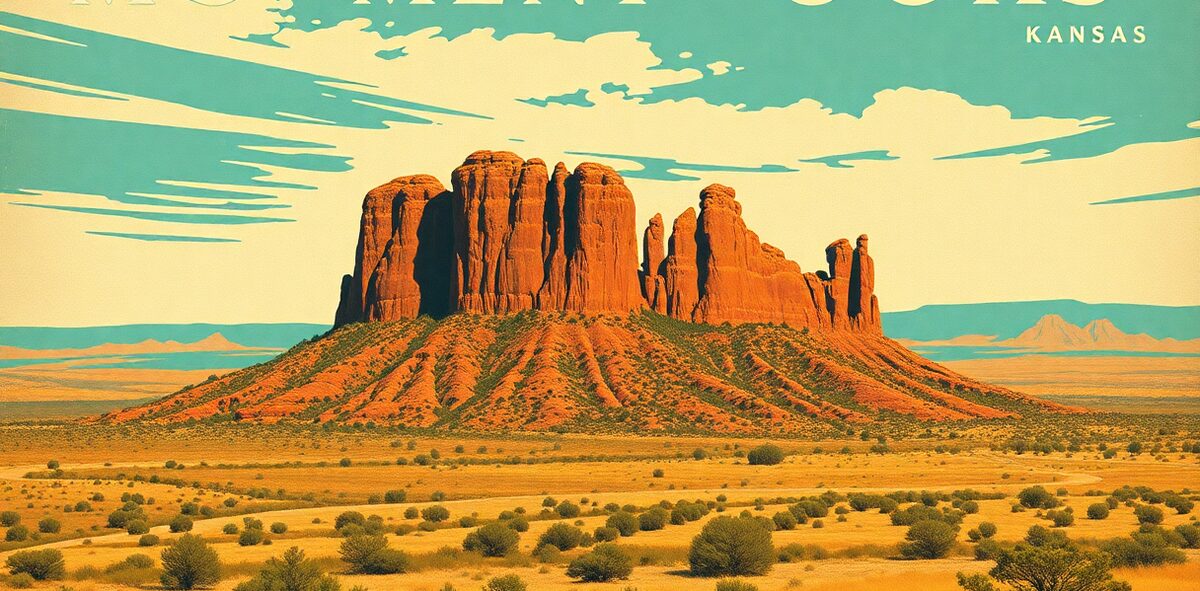
Monument Rocks Guide


Non-negotiable: a line of chalk spires up to 70 feet tall rises straight out of the flat western Kansas grassland, roughly 80 million years old, free to walk right up to, and usually deserted. Time it for golden hour and you’ll have one of the state’s most striking sights entirely to yourself.
Why it earns the drive
These aren’t rock — they’re Niobrara chalk, the compressed floor of the Western Interior Seaway, an inland ocean that split the continent in two during the Late Cretaceous. Wind and rain carved the bed into pyramids, buttresses, and a natural arch after the sea drained. In 1968 they became the first National Natural Landmark designated in Kansas. The chalk is stuffed with marine fossils — the same beds nearby produced the giant fish and sea reptiles now on display at Hays.
Three things the blurb skips. First, they sit on private ranch land, and the owners simply let people visit for free — a handshake arrangement, not a park. Second, there are zero facilities: no gift shop, no restroom, no water, no ranger, no cell signal. Third, the payoff is entirely about light and timing — the same spires that look like a chalky lump at noon turn to fire at dusk, which is why the person who plans around golden hour gets a completely different place than the one who rolls up midday.
The move
Drive US-83 south from Oakley about 25 miles, then east on graded county dirt to the formations. Come at sunrise or sunset, when the low sun lights the white chalk gold and the shadows do all the work. Walk the loop around the spires and find the natural arch on the south cluster. Bring water, sun cover, and a full tank — the nearest gas is back in Oakley. Download an offline map; the roads aren’t well signed and there’s no one out here to ask.
The honest catch — what to skip
Skip it entirely after rain. The graded dirt roads turn to greasy gumbo that strands trucks, let alone a sedan, and there’s no cell service and no tow. Skip midday if you can — the flat overhead sun bleaches out the color and the drama. And don’t climb on the chalk: it’s soft, it crumbles, and this is a courtesy-access site that stays open only because visitors behave. If the roads look questionable, pair the trip with nearby Castle Rock — a single lone spire even more remote — only when everything’s bone dry.
Nearby
Run it as the western chalk circuit with Little Jerusalem Badlands State Park, the largest Niobrara exposure in the state, about 20 miles south. Base out of Hays and pair it with the Sternberg Museum’s fish-within-a-fish fossil, dug from these same seabeds. It’s a flagship of the western third of the Kansas guide — proof the flat-and-boring rap dies the moment you leave the interstate.
| Cost | Free |
|---|---|
| Time needed | 1–2 hours + the drive out |
| Best season | year-round; avoid the roads after rain |
| Where | Gove County · The High Plains Alabama |
📍 Where: Monument Rocks, Gove County, Kansas · 38.7935, -100.7621
Common questions
Where exactly is Monument Rocks and how do you get there?
In Gove County, western Kansas, about 25 miles south of Oakley off US-83, then several miles east on graded county dirt roads. It's roughly a 4-hour drive west of Salina. There's no town in sight and no signage until you're nearly there, so download an offline map before you leave pavement.
How much does it cost, and is it public land?
Free. The formations sit on private ranch land, but the owners keep it open to the public at no charge during daylight hours. Treat it like someone's property, because it is — no climbing on the chalk, no littering, no camping.
Are the roads passable for a regular car?
In dry weather, yes — a normal sedan handles the graded dirt fine. After rain the roads turn to slick gumbo that strands even trucks, so never attempt them wet. Check the forecast and the road surface; there's no cell service and no one to pull you out.
What's the best time of day to see them?
Sunrise or sunset. The chalk glows gold and orange at golden hour and the long shadows carve out the spires and the natural arch. Midday sun flattens everything to a chalky white. Early or late also means you'll likely have the place entirely to yourself.
How long do you need, and what should you bring?
Plan 1–2 hours on site plus the drive out. Bring water, sun cover, and a full tank — there's no shade, no restroom, no water, and no gas for miles. Cell coverage is spotty to nonexistent.
Is it worth the drive?
Non-negotiable. These became the first National Natural Landmark in Kansas in 1968, they're free, and they're the fastest way to blow up the flyover-state reputation. Chalk pyramids older than the Rockies, standing alone on the grass.
One of 120 in Kick the Bucket List: Kansas
The full book is 120 checkable picks like this one — with a Bucket Rating on every entry telling you what's worth the drive and what to skip. A keepsake you fill in and score.
Get the Kansas book →More Kansas Kick-It Picks
Watch Half a Million Birds Drop Into Cheyenne Bottoms
Worth the driveTouch a Spacecraft That Went to the Moon
Non-negotiableWalk the Santa Fe Trail in Council Grove
Worth the driveDrive the Flint Hills Scenic Byway
Non-negotiableVerified 2026-07. Prices and hours change — confirm before you drive. Something wrong? Tell us.