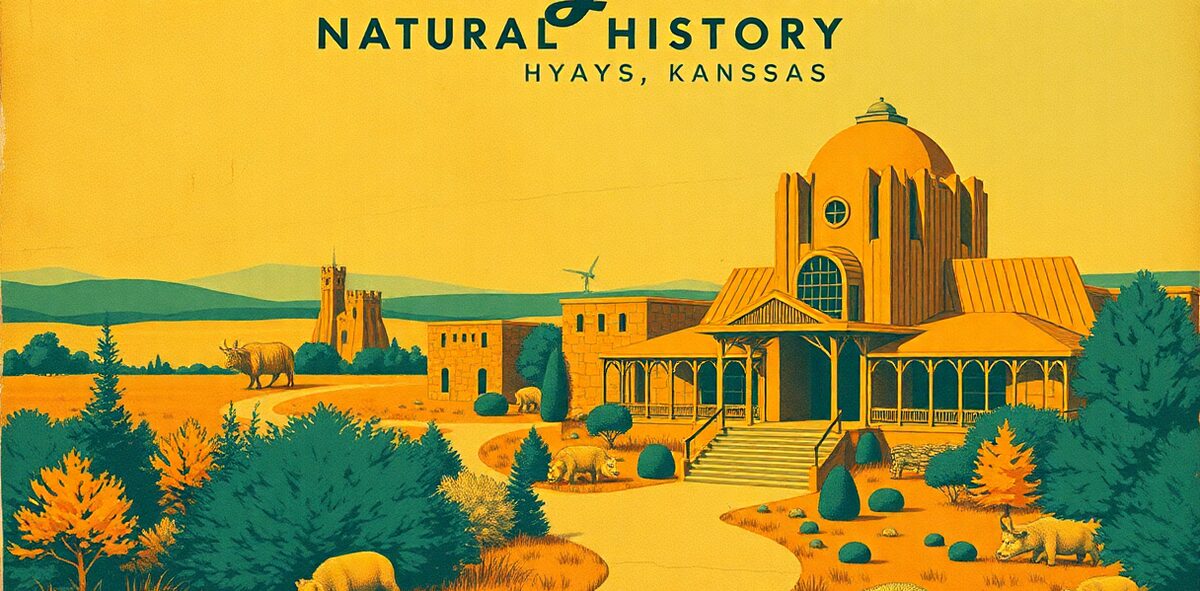
Sternberg Museum of Natural History Guide


Worth the drive: western Kansas was the floor of a vast inland sea 80 million years ago, and the Sternberg holds its monsters — chief among them the Fish-within-a-Fish, a 14-foot predator fossilized with its last meal, a 6-foot fish, still inside its gut. It’s one of the most spectacular fossils on Earth, and it came out of the dirt right here.
Why it earns the stop
The star is a 14-foot Xiphactinus, a fanged Cretaceous fish, preserved with a roughly 6-foot Gillicus intact in its stomach — it swallowed prey too big, died trying, and both sank together to the seabed. George F. Sternberg found it, and the museum built around his family’s legendary fossil-hunting work. But the whole Western Interior Seaway collection is the draw: giant marine reptiles, mosasaurs, plesiosaurs, and flying pteranodons with wingspans over 20 feet, all pulled from the same Niobrara chalk you see standing at Monument Rocks.
Three things the blurb skips. First, admission is a bargain — about $9 for adults, cheaper than most kids’ museums for a genuinely world-class collection. Second, it sits on the Fort Hays State University campus, so it’s an active research institution, not a tourist trap; the fossils are the real specimens. Third, the immersive Cretaceous seaway exhibit is a walk-through, not a case to peer into — life-size reptiles loom at eye level and overhead, which is why kids and adults both come out talking about it.
The move
Go straight to the Fish-within-a-Fish — it’s the anchor and the story sticks. Then do the Cretaceous seaway walk-through and the dinosaur hall. Budget 1.5 to 2 hours; this is a full museum, not a roadside curio. Check summer hours (roughly Mon–Sat 9–6, Sun 1–6, March through September) before you drive, since Mondays close in winter. Hays sits just off I-70, so it slots easily into a westbound road day.
The honest catch — what to skip
This is an indoor museum in a college town, so don’t expect a half-day epic — 90 minutes to 2 hours is the honest range, and rushing it in 30 minutes wastes the trip. If you’re chasing only the fossil, know that the surrounding exhibits are what make the admission worth it, so give them the time. And plan around the calendar: winter Mondays are closed, and holiday hours shift. It’s a stop that shines most when you’ve already seen the chalk it came from — museum first without the field, or field first without the museum, and you get half the story.
Nearby
Fold it into the western chalk country: Monument Rocks and Little Jerusalem Badlands State Park expose the same Niobrara seabeds these fossils came from, both an easy day-trip southwest of Hays. Farther out, the Cosmosphere in Hutchinson pairs deep time with the space age for a science-heavy Kansas run. It’s a headliner of the western half of the Kansas guide.
| Cost | ~$9 adults |
|---|---|
| Time needed | 1.5–2 hours |
| Best season | year-round |
| Where | Hays · The High Plains Alabama |
📍 Where: Sternberg Museum of Natural History, Hays, Kansas · 38.8894, -99.2998
Common questions
What is the Fish-within-a-Fish fossil?
A 14-foot Xiphactinus — a fanged predatory fish from the Late Cretaceous — fossilized with a roughly 6-foot Gillicus still intact inside its stomach. It swallowed prey too large, apparently died in the attempt, and both sank to the seafloor together about 80 million years ago. It's one of the most famous fossils on Earth, and it was dug up right here in western Kansas.
How much is admission and what are the hours?
As of 2026, adult admission runs about $9, with reduced rates for youth (around $6), seniors (around $8), and Fort Hays State students. Summer hours (March–September) are roughly Monday–Saturday 9 am–6 pm and Sunday 1 pm–6 pm; winter closes Mondays. Confirm at sternberg.fhsu.edu before you go.
Is it good for kids?
Very. The immersive walk-through Cretaceous seaway puts life-size mosasaurs, plesiosaurs, and pteranodons at eye level and overhead, and there's a dinosaur hall and hands-on areas. Kids who like fossils could easily run 2 hours; it's built to hold both children and adults.
Where is it and how far is the drive?
On the Fort Hays State University campus in Hays, just off I-70 in western Kansas — roughly 3 hours west of Salina and about 4.5 hours from Kansas City. Hays is the natural base for the western chalk country, so most people fold it into a bigger trip.
How long do you need?
Plan 1.5 to 2 hours. That covers the Fish-within-a-Fish, the Cretaceous seaway walk-through, the dinosaur hall, and the rotating exhibits without rushing. It's a full regional natural-history museum, not a five-minute photo stop.
Is it worth the drive?
Worth the drive. The star fossil is genuinely world-class, the sea-reptile collection is one of the best anywhere, and it makes the natural sense of the Kansas chalk country — Monument Rocks, Little Jerusalem — click into place. Pair it with those and it's a full High Plains day.
One of 120 in Kick the Bucket List: Kansas
The full book is 120 checkable picks like this one — with a Bucket Rating on every entry telling you what's worth the drive and what to skip. A keepsake you fill in and score.
Get the Kansas book →More Kansas Kick-It Picks
Watch Half a Million Birds Drop Into Cheyenne Bottoms
Worth the driveTouch a Spacecraft That Went to the Moon
Non-negotiableWalk the Santa Fe Trail in Council Grove
Worth the driveDrive the Flint Hills Scenic Byway
Non-negotiableVerified 2026-07. Prices and hours change — confirm before you drive. Something wrong? Tell us.